What open area controls
Open area is the fraction of a perforated sheet that is hole rather than metal, given as a percentage of the perforated field, and it decides several things at once.
Airflow through a grille, a guard or a ventilation screen scales with it: at the same pressure difference, more open area passes more air. Light follows the same geometry square on, but at a low sun angle the hole walls shade part of each opening, so a sunshade in Riyadh's afternoon light behaves as if it were less open than its figure. Sound on an acoustic panel passes through the face to the absorbent layer behind, so the face has to be open enough not to send it back into the room. Weight falls in step: a perforated sheet weighs the solid sheet minus the open share, and the perforation service quotes on that net figure. The view through the panel is open area, hole size and viewing distance together.
What it does not decide is what passes through a single hole: a sieve, a finger guard or a debris screen is specified by hole size first, because two sheets at 35 % open area with 3 mm and 10 mm holes pass entirely different things. Write both numbers down.
The three patterns and their formulas
Every regular perforation is a hole repeated on a grid, and open area is the area of one hole divided by the area of the cell it occupies. Three patterns cover most drawings.
Round holes on a straight pitch sit on a square grid: the cell is a square of side p holding one hole of diameter d, so open area is π × d² ÷ (4 × p²) × 100. Round holes on a 60° staggered pitch offset each row by half a pitch, so the cell becomes a rhombus of area p² × √3 ÷ 2 holding the same hole, and open area is π × d² ÷ (2 × √3 × p²) × 100. Square holes of side a on a straight pitch give (a ÷ p)² × 100. In each case the pitch is the centre-to-centre distance between neighbouring holes, and the bridge, the narrowest strip of metal between two holes, is p − d. The engine refuses a hole that is not smaller than its pitch, because the holes would overlap. Try it on the perforated sheet open-area calculator, where a fourth calculation turns a solid sheet weight into the net weight after perforation.
حاسبة المساحة المفتوحة للصفائح المثقبة
ثقوب دائرية — تباعد مستقيم
المساحة المفتوحة لحقل التثقيب وحده. الحواف والهوامش غير المثقبة تخفض رقم الصفيحة كاملة.
The table takes one hole size and one pitch through all three patterns on a 3000 × 1500 × 2 mm sheet of 304, supplied to ASTM A240 or EN 10088-2. The solid sheet weighs 72 kg at the material master density of 8000 kg/m³, from the sheet and plate weight calculator: 3000 × 1500 × 2 × 8000 ÷ 10⁹. Net weight is that figure × (1 − open area ÷ 100).
| Pattern | Hole | Pitch | Open area | Net weight of the 72 kg sheet |
|---|---|---|---|---|
| Round holes, straight pitch | 5 mm diameter | 8 mm | 30.68 % | 49.91 kg |
| Round holes, 60° staggered | 5 mm diameter | 8 mm | 35.43 % | 46.49 kg |
| Square holes, straight pitch | 5 mm side | 8 mm | 39.06 % | 43.88 kg |
Why the staggered pattern packs tighter and is usually stronger
Offsetting alternate rows by half a pitch fits the same holes into a smaller cell. A square cell has area p²; the rhombus of the staggered grid has area p² × √3 ÷ 2, about 0.866 p². The same hole in a cell 86.6 % the size gives an open area 2 ÷ √3 times larger, a factor of 1.1547, which is where "about 15 % more" comes from, for any hole and pitch.
The bridge is the same p − d in both patterns, 3 mm in the table, but it runs in different directions. On a straight pitch the bridges line up as continuous bars in two directions at right angles, so a load path along a row travels the whole way on a 3 mm bar. On a staggered pitch the narrowest bridges run in three directions at 60° to each other, and any straight line across the sheet crosses them rather than following one. The guidance on this site's calculator says the staggered pattern is the stronger of the two for a given open area, which is why it is the usual default and why most standard tooling is staggered. State on the drawing which way the stagger runs; two panels side by side only match if it runs the same way.
Margins, borders and the whole-sheet figure
The three formulas describe an endless field of holes. A real sheet has edges, and the perforated field stops short of them: a blank margin the tooling needs to grip the sheet, a border for a frame or a fold, and blank strips around fixings and cut-outs. The calculator's open area is for the perforated field only, and unperforated borders and margins bring the whole-sheet figure down.
The whole-sheet open area is the field figure multiplied by the share of the sheet the field covers. Take the staggered row of the table on its 3000 × 1500 mm sheet with a 25 mm blank margin on every side. The sheet is 4.5 m²; the perforated field inside the margins is 2950 × 1450 mm, 4.28 m², or 95 % of the sheet. The field's 35.43 % becomes roughly 33.7 % over the whole sheet. On a small panel the same margin takes a much larger share, and a folded return, blank along the fold and the return, takes more still.
Which figure the specification means has to be written down, because a perforator reads "35 % open area" as the field and an acoustic consultant may mean the face of the finished panel. State the margins on the drawing, say whether partial holes at the edge of the field are acceptable, and give the fold lines, because a fold through a row of holes distorts them and the pattern is usually interrupted for a blank band along the fold. The perforation service confirms hole size, pitch and margin together at enquiry.
Strength and flatness at high open area
Every hole removes metal, and a perforated sheet is never as stiff or as strong as the solid sheet it came from. The bridges carry the load, and as open area rises they thin faster than the percentage suggests. Push the staggered pattern from an 8 mm pitch to a 6 mm pitch with the same 5 mm hole and the engine gives 62.98 % open area, while the bridge falls from 3 mm to 1 mm: on a 2 mm sheet, a strip narrower than it is thick, carrying everything. As a working rule, open area above roughly 50 % costs stiffness that has to be bought back elsewhere, in a thicker sheet, a smaller panel or a frame.
Flatness goes the same way. Punching stretches the metal around every hole and leaves it in residual stress, so a sheet perforated over most of its area comes off the press with a bow or a ripple that has to be levelled. A laser-cut pattern puts heat instead of stretch into the bridges, and fine bridges hold that heat. Thicker sheet allows finer bridges in either process, which is why a perforator checks the bridge width against the thickness first, not the open area alone.
The remedies are the ones mashrabiya makers have always used: folded edges or a frame give back the stiffness the pattern took away, blank bands carry the folds and fixings, and a large façade is split into panels that stay flat between their supports. The mashrabiya page sets these out as design decisions.
Choosing a pattern for façades, screens and acoustic panels

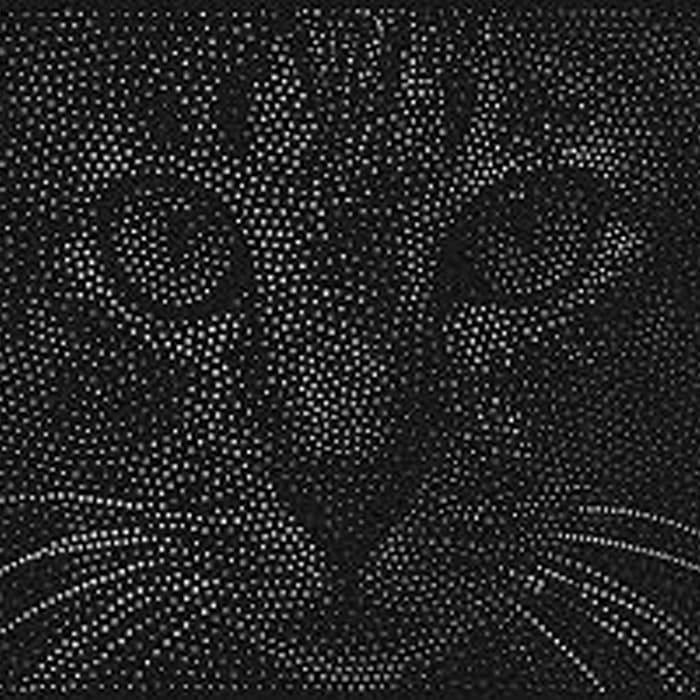
For a façade or a sunshade, open area sets the shade and the view and hole size sets how the panel reads: filigree at arm's length is texture from the street, so the repeat is chosen against the viewing distance. Graded patterns, and images translated into holes like the halftone panel above, keep the pitch and vary the hole size, so the open area changes across the panel and the calculator figure applies zone by zone. Choose the finish after the geometry is settled: brushed, mirror or PVD each change how the holes read, and stainless steel finishes decoded covers what each does with light. Where aluminium panels sit on a stainless subframe, or the reverse, the joint needs isolating; galvanic corrosion in mixed-metal façades explains why and how.
For a screen, a guard or balustrade infill, hole size is the safety number and open area is the airflow and view number; set them separately and check them against each other. Where the panel has to be stiff at low weight, expanded metal is the alternative: the sheet is slit and stretched rather than punched, nothing is removed, and the mesh is light for its stiffness. What is mashrabiya covers the screen as the region's own answer to sun, air and privacy at once.
For an acoustic panel, the face has to be open enough to let sound through to the absorber behind it; the absorber, the cavity and the mounting do the rest. Small holes at a close pitch give the same open area as large holes at a wide pitch with a different look: 3 mm holes on a 5 mm staggered pitch give 32.65 %, within three points of the table's 5 mm holes on an 8 mm pitch, and the two panels could not be mistaken for each other. The acoustic specification sets the open area; the architect chooses the pattern that reaches it.
Where Hidayath fits
Hidayath Metal Industries operates from three cities, ten locations and three factories in Saudi Arabia, with branches in Jeddah, Riyadh and Dammam; the group began in 1976. The perforation service perforates stainless steel, aluminium and carbon steel in standard round, square and slotted patterns, and cuts custom patterns, mashrabiya geometry, graduated openings and images translated into hole sizes from the designer's file. The finished panel can be folded, framed and PVD-coated in the same building. The open-area calculator runs the same engine that prices the work, and every result offers a pre-filled request for quotation.