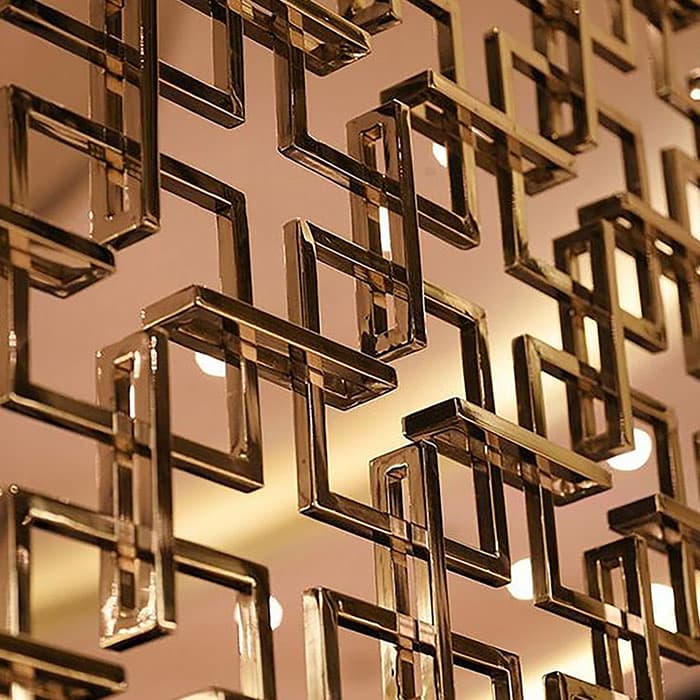
A mashrabiya is a screen. In the traditional houses of Cairo, Jeddah and the Gulf it was a projecting window enclosed by a lattice of turned wood, and it did three jobs at once: it let air move through the room, it cut the sun to a pattern of light on the floor, and it let the people inside see the street without being seen. The word is usually traced to the Arabic for drinking; the lattice held clay water jars where the moving air cooled them.
The geometry that came out of that tradition — the eight-pointed star, the interlocking hexagon, the repeating rosette — is now one of the most recognisable vocabularies in the region's architecture, and most of it is no longer made of wood.
Mashrabiya in metal
A modern mashrabiya is a perforated or laser-cut panel. The pattern is drawn as a vector file, the sheet is cut so the openings become the pattern, and the panel is fixed as a screen: a facade sunshade, a balustrade infill, a partition between a lobby and a lift bank, a ceiling that filters light. Metal lets the panel be thinner, larger and flatter than wood, lets it be folded into cassettes, and lets it carry a finish — brushed, mirror, PVD gold or bronze — that wood cannot.
It is also less forgiving. In wood, a lattice is assembled from pieces; in a cut sheet, every opening removes material from one continuous panel, and the panel has to stay stiff and flat with the pattern taken out of it. That is the design problem of a metal mashrabiya, and it is where the drawing and the workshop meet.
What decides whether a pattern works
- Open area: the share of the sheet removed. Enough for the air, the light or the view; not so much that the panel loses its stiffness or the bridges between openings become too thin to cut cleanly.
- Bridge width against thickness. The narrowest strip of metal left between two openings has to survive the cut, the handling and the heat of the laser without warping. Thicker sheet allows finer bridges; a very fine pattern in thin sheet will not stay flat.
- Scale and viewing distance. A pattern that reads as filigree at arm's length reads as texture from the street. The repeat is chosen against where the panel will be seen from.
- Fixing and framing. A perforated panel is often folded at the edges or framed to give back the stiffness the pattern took away. Cutting, folding and finishing in one facility means those decisions are made together.
Traditional or contemporary
Both come from the same kind of file. Some projects reproduce a historic lattice; more take the logic of the tradition — repetition, layered depth, the play of light and shadow — and draw something new. A graduated pattern whose openings grow across a facade, or an image translated into hole sizes, is still mashrabiya in the sense that matters: a screen that gives shade and privacy while letting the building breathe.
We cut both, straight from the designer's file. Send the drawing and we will say what the sheet will hold.