Hospitality
Decorative stainless steel, PVD finishes and architectural metalwork for hotels, restaurants and resorts.
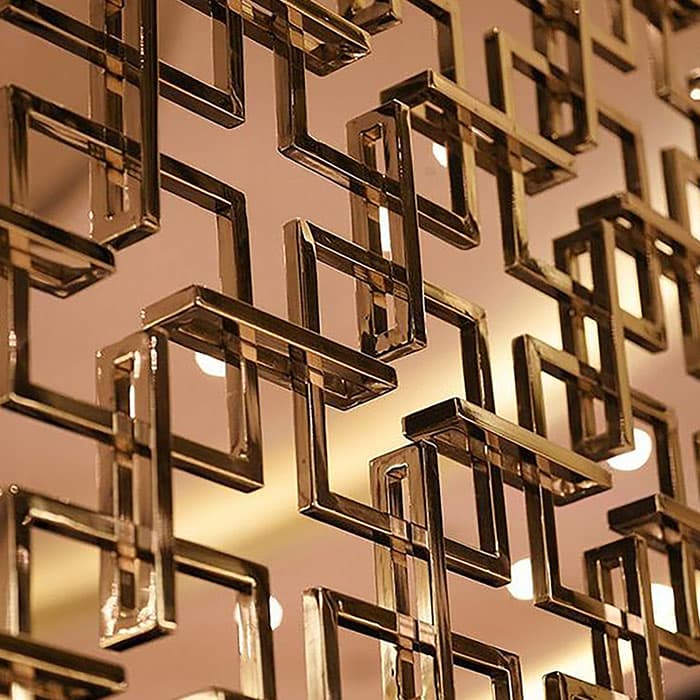
Hotels are judged in the lobby, the lift car and the restaurant, and much of what guests read as luxury there is finished metal: a champagne-brushed lift door, a bronze mashrabiya screen filtering the light, a mirror-polished reception counter edge. We fabricate and finish that metalwork for hotels, resorts, restaurants and hospitality fit-outs across Saudi Arabia, from architectural drawings through PVD colouring to installation-ready panels.
The range covers PVD-coloured stainless in the decorative product line, laser-cut screens and mashrabiya, lift and column cladding, and the counters, handrails and feature elements that carry the interior designer's intent. This page explains what we make, how to choose the grade and finish so the piece still looks right after years of housekeeping, and what a designer's enquiry should contain.
What we fabricate and finish for hospitality projects
- PVD colouring of stainless in gold, rose gold, bronze, champagne, black and other tones, applied over a brushed, mirror, vibration or patterned base.
- Laser-cut screens and mashrabiya for lobbies, restaurants, spas and façades, cut from stainless, brass or aluminium to the designer's pattern or drawn from our own library.
- Lift cladding: car interiors, landing doors, jambs and architraves, PVD-coloured to match the corridor scheme.
- Laser cutting and V-grooving for sharp-cornered wrapped columns, counter cladding, skirtings and reveals.
- Perforated ceilings, acoustic panels and light-filtering screens.
Choosing the grade and finish for a hotel
Interiors in Riyadh and other inland cities are well served by 304 in every finish, including PVD. Coastal hotels in Jeddah, the Red Sea developments and the Eastern Province move to 316L for anything outside the conditioned envelope: entrance canopies, pool areas, terraces, and screens on the sea-facing façade. Where the design calls for real brass, C27200 brass sheet is cut and formed, and PVD bronze over stainless is offered as the alternative that does not tarnish.
Finish choice is where hotels win or lose the maintenance argument. A hairline or champagne brushed base hides fingerprints and light scratching; a mirror finish shows both and belongs on surfaces that hands do not reach. Anti-fingerprint coatings help on lift panels and door pulls. Textured bases such as hammered, water ripple and bronze etch carry PVD colour well and disguise wear. The guide to 2B, BA, No.4, hairline and mirror explains how the bases differ, and what PVD stainless is covers how the colour is applied and why it outlasts paint and plating.
Detailing that survives housekeeping
Hotel metal is cleaned daily with whatever the housekeeping trolley carries, so detailing has to protect the finish. V-grooved and folded corners keep the grain continuous around a column instead of breaking it with a welded seam; concealed fixings and returned edges avoid a raw cut on view; PVD panels are protected with film through installation and handed over with a cleaning note that names what not to use. Sample panels in the chosen finish and colour are made before the run, so the designer signs off a physical piece rather than a rendering. The article on V-grooving shows the corner detail that makes wrapped cladding look like solid metal.
What a good enquiry contains
The elevations or shop drawings, the finish reference and PVD colour for each element, the base pattern, the grade, the thickness, whether the item is interior or exterior and coastal or inland, and the installation method. For screens: the pattern file or a reference image, the panel sizes and the open-area intent. Weights for a wall of panels can be checked on the sheet and plate weight calculator. When the schedule is defined, send the enquiry with the sample requirement stated; a sample first saves the project a colour argument later.
Common questions
Will PVD gold or bronze fade in a hotel lobby?
PVD is a hard ceramic-metal layer bonded to the stainless, not a paint or plating, so under normal interior use and correct cleaning the colour stays. The failures we see come from abrasive pads or chlorine-based cleaners on the surface, which is why every handover includes a cleaning note and why brushed or textured bases are recommended where hands and trolleys touch.
Can you match a colour from another supplier's sample or a designer's swatch?
Usually, within the range the process allows. We produce a sample panel on the specified base finish, the designer compares it against the swatch under the project's lighting and approves or adjusts before the production run. Colour reads differently on mirror, hairline and vibration bases, so the sample is always made on the base the project will use.
Do you make custom mashrabiya patterns or only standard ones?
Both. Designers send a pattern file and we prepare it for cutting, checking bridge widths and panel sizes so the screen is stiff enough and cleanly cut. Where there is no pattern yet, we offer geometric families from our library that the designer can scale and adapt, and the article on what mashrabiya is covers the tradition the patterns come from.
Which grade should a beachfront resort use for exterior screens?
316L as the floor, with the finish chosen to tolerate salt fog: brushed or textured rather than mirror, and PVD colour applied over it if the scheme needs warmth. The article on why 304 stains near the Saudi coast shows what happens when the lower grade is used outdoors by the sea.
What serves this industry
 01Laser CuttingPrecision laser cutting for sheets and plates in stainless steel, aluminium, carbon steel and other suitable materials — from one-off prototypes to repeat production runs.View service
 02V-GroovingV-grooving and folding of stainless steel and decorative sheet for sharp-cornered cladding, column wraps, frames and interiors — the crisp edge ordinary bending cannot give.View service
 03PerforationPerforated and patterned sheet in stainless steel, aluminium and carbon steel — facade screens, balustrade infill, ceilings, grilles and mashrabiya, in standard or custom patterns.View service
 04PVD CoatingPhysical vapour deposition on stainless steel — coloured finishes bonded to the metal in a vacuum chamber, in-house, for lobbies, facades, lifts and fittings that have to keep their colour.View service
Working in this industry?
Send the enquiry with your sector named — it reaches the division that serves it, with the context attached.