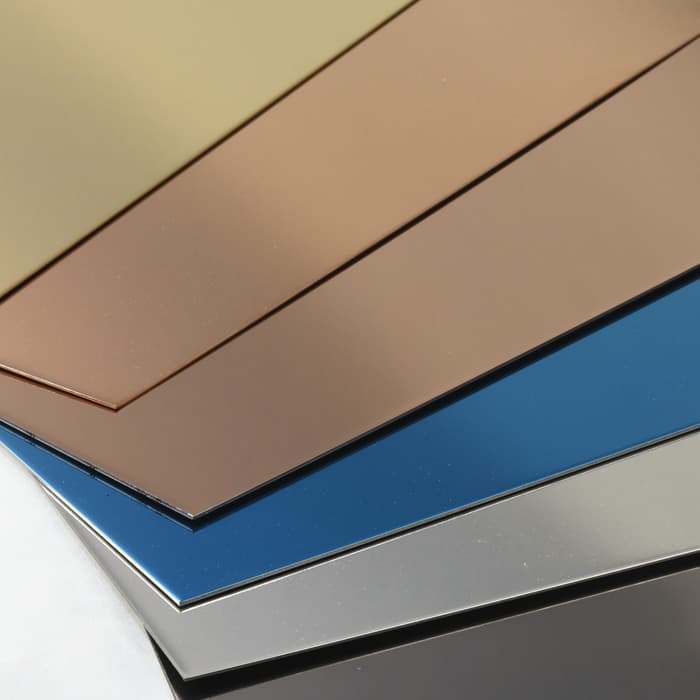
Mill finishes: 2B, BA and No. 1
A mill finish is the surface the sheet has when it leaves the rolling mill: a by-product of how the strip was rolled, annealed and cleaned, not a surface made for looks. ASTM A480 defines the designations most orders use; EN 10088-2 defines the equivalent process routes.
No. 1 (1D in EN 10088-2) is hot-rolled plate, annealed and descaled by pickling: dull, slightly rough, the plate finish from 3 mm upwards. If a No. 1 plate has to be seen, it gets polished.
2D is cold-rolled sheet, annealed and pickled: matte, grey, even. 2B is 2D given one light pass through polished rolls, the skin pass, which flattens the surface into a soft, slightly reflective grey. 2B is what most 0.4 mm to 3 mm sheet arrives as, what fabrication starts from, and the base most polished finishes are built on.
BA, bright annealed (2R), is annealed in a protective atmosphere instead of in air, so no scale forms and no pickling is needed. The surface keeps the brightness the cold rolls gave it, far more reflective than 2B and close to a mirror at a glance; it normally ships with a protective film on the face.
Side by side: 2B returns a soft, diffuse image, BA a clear reflection with a faint haze. Neither has a grain direction, so sheets can be turned freely. Both carry a shade set by the mill, so 2B from two heats can differ; for visible panels, ask for one heat or move to a polished finish.
Mechanical finishes: No. 4, hairline, satin and bead blast
A mechanical finish is applied after the mill, by abrasive, and replaces the mill surface with one the polisher controls, so it can be matched across a project in a way a mill finish cannot: the polishing service holds the specification from first panel to last and re-grains welded joints into the same surface.
No. 4 is the general-purpose polished finish in ASTM A480: a linear grain from a medium abrasive, short and uniform. No. 3 is the coarser version; in EN 10088-2 the nearest code is 2J, brushed or dull polished.

Hairline is a trade name, not an A480 designation. A hairline finish is a longer, finer, unbroken line running the full length of the sheet, so butt-jointed panels with the grain held one way read as one surface. A brush finish is the softer, shorter grain in the same direction. Both are produced on 2B sheet, and both need the grain direction on the drawing.
Satin is a dull, low-reflection linear finish with the grain softened; ASTM A480 lists No. 6 as a dull satin, and EN 10088-2 calls a satin polish 2K. On ornamental tube to ASTM A554 the same family is sold as brush (No. 400), satin and No. 600 standard polish; those numbers name a polishing sequence, not ASTM A480 designations.
Bead blast, the pearl bead finish in the finish library, is not polished at all: fine media is blasted at the sheet, leaving a uniform, non-directional matte, so panels can be placed in any orientation. It has no code in either standard and is specified by sample. Its relative is the vibration finish, a short multidirectional swirl from an orbital abrasive, which hides handling marks better than any linear finish.
Mirror: No. 8
No. 8 in ASTM A480 is the finish with the highest reflectivity, and 2P, bright polished, is the EN 10088-2 route. A mirror finish is made by polishing through successively finer abrasives and then buffing, until the grit lines are gone and the surface returns a clear image with no haze. On A554 tube, No. 800 super mirror is the same end point.
BA is sometimes offered as a substitute for mirror, and it is not one. BA is a rolled surface carrying whatever the rolls carried; No. 8 is a removed surface, the mill layer taken off and the metal buffed. For a ceiling seen at a distance BA may be enough; for a lift car wall at arm's length, or as a base for a PVD colour, it is not.
Mirror also shows everything, fingerprints, fine scratches and a half-blended weld included, because the surface has nothing of its own to hide them behind. That is why the finish library places mirror above hand height or under an anti-fingerprint coating.
| Finish | How it is made | Grain direction | Best use | PVD base |
|---|---|---|---|---|
| No. 1 (1D) | Hot rolled, annealed, descaled | None; dull rolled surface | Plate from 3 mm for structural and process work | No |
| 2B (2B) | Cold rolled, annealed, pickled, skin passed | None | General-purpose sheet, fabrication, the base for polished finishes | Confirm at enquiry; the mill surface shows through |
| BA (2R) | Cold rolled, bright annealed, no pickling | None | Reflective surfaces seen at a distance, trim work | Confirm at enquiry |
| No. 4 (2J) | Linear polish with a medium abrasive on 2B | Directional, short grain | Kitchens, lift cars, handled surfaces | Yes; the standard brushed base |
| Hairline (no code; nearest 2J) | Fine continuous linear polish, full sheet length | Directional, unbroken lines | Lift doors, cladding where panels butt-joint | Yes; the standard base on lift doors |
| Bead blast (no code) | Fine media blasted at the surface | None; uniform matte | Signage, furniture, panels cut in any orientation | Yes; takes colour evenly |
| No. 8 (2P) | Polished through finer abrasives, then buffed | None; reflective plane | Ceilings, signage, feature surfaces above hand height | Yes; the base for most PVD colours |
Which finish hides scratches and which shows fingerprints
On a mirror every scratch shows, because the surroundings are flat. On a linear finish a scratch along the grain vanishes and a scratch across it shows, which is the argument for laying the grain the way the traffic runs: vertical on a lift door, horizontal along a corridor. On bead blast or vibration a scratch has no grain to be across, and the surface is already full of short marks, so those two suit counters and furniture that will be knocked.
A fingerprint is a film of oil that changes how light reflects, so it shows where the surface reflects cleanly: mirror first, BA close behind, then the finer linear finishes. A No. 4 breaks the reflection up enough that a print is hard to see; bead blast hides it almost completely. Cleaning runs the other way: a grained surface holds dirt and is wiped along the grain, a mirror releases dirt but shows the cloth marks, a bead blast holds dust and needs washing.
Which finishes take PVD, and why the base matters more than the colour
Physical vapour deposition puts a thin film of a metal compound onto the stainless surface in a vacuum chamber, and the film follows the surface it lands on. So what PVD is and what it does not do starts where this article does: the base finish is half the specification. The same gold on a mirror is a reflective gold; on a hairline, a directional, softer gold; on a bead blast, a matte gold with almost no reflection. The PVD service coats over hairline, mirror, bead blast and vibration, and the mono and dichromic colour range is offered over any mechanical base.

The mechanical finishes make the best bases because the polishing line has already replaced the mill surface with a controlled one. A film that shows a scratch through it also shows the roll marks and heat-to-heat shade a 2B or BA surface may carry, so coating a mill finish is a question for enquiry. Write the base finish and the colour as two lines, and finish the base first: weld blending and re-graining happen before coating, because fabrication after coating marks the film.
Matching finish to place: lobby, kitchen, façade, lift interior
A hotel lobby is a mixed case. Above hand height, mirror and PVD-on-mirror give the reflection and colour the design wants, and nobody touches them. At hand height the same surface would carry prints within an hour of opening, so: hairline or vibration where hands go, mirror where they do not, anti-fingerprint coating where mirror must come down to touching height.
A commercial kitchen wants No. 4. The grain hides the scratches that pans and trolleys leave, the surface is wiped along it, and there is no coating to wear. Mirror in a kitchen is a mistake within a week; bead blast holds grease.
On the Jeddah and Dammam coasts, airborne chloride settles on external stainless and the humidity keeps it wet at night; a coarse linear grain is a set of grooves that hold that deposit, and a smoother surface holds less and washes cleaner. Why 304 stains and pits near the Saudi coast sets out the grade and finish levers together; the short version is a finer finish, the grain laid vertical so the panel drains, and 316 or 316L rather than 304. In Riyadh the enemy is dust on metal at 45 °C rather than salt, and a non-directional finish that does not collect dust in a grain is easier to keep. Where the façade is a screen rather than a panel, the open pattern matters as much as the surface: see choosing hole size and pitch for perforated sheet.
A lift interior is the finish library's home ground: hairline on the doors, grain vertical and continuous across the leaves so the joint reads as one line; vibration or hairline on the car walls at hand height; mirror or PVD on the ceiling and upper panels.
Whatever the place, agree the surface on a physical sample, not a name. A No. 4 from two polishing lines can differ more than a No. 4 and a hairline from one, and neither standard fixes a roughness figure that settles the argument; the sample, referenced on the purchase order, does.
Where Hidayath fits
Hidayath Metal Industries holds stainless steel coil in BA and 2B in the thin gauges, adds No. 4 from 1.2 mm, and holds plate gauges in No. 1. Sheet is held in 2B and in the surfaces the plant produces: brushed, hairline, vibration, mirror, etched, PVD, embossed and perforated, with No. 1 plate from 3 mm. Ornamental tube to ASTM A554 is polished in-house from 2B through brush and satin to super mirror. The polishing service produces the brushed, satin and mirror finishes on sheet, plate, tube and fabricated work, re-grains welded joints and prepares the base for PVD; the PVD service coats in the same building, so base finish, fabrication and colour are one order. Physical samples of any finish on any grade come through the sample request.