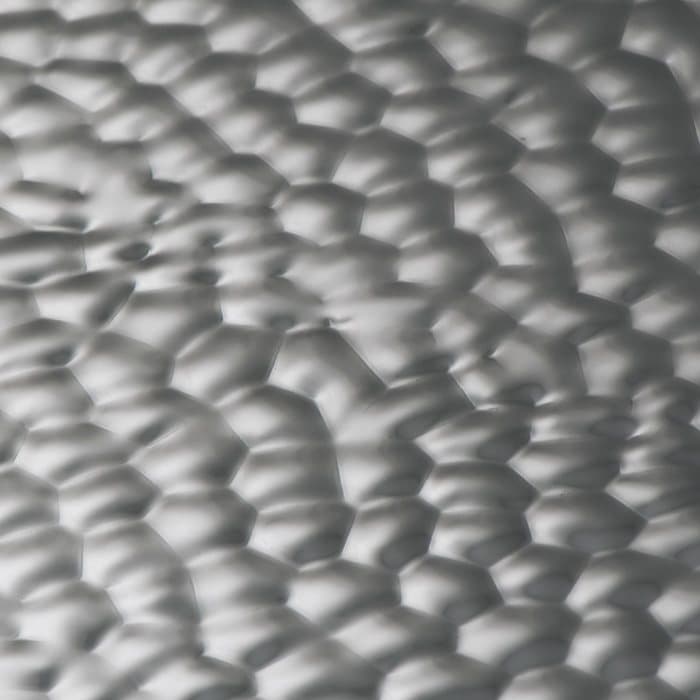
Polishing is the finish the client sees and touches, and in stainless steel it is most of what "finish" means. We polish sheet and plate, tube and pipe, and fabricated assemblies, in-house, to the standard grain and mirror finishes the trade specifies and to the decorative textures shown in our finish library. The same line that polishes a flat sheet re-grains a welded balustrade so the joint disappears into the grain, and prepares a surface for PVD so the coating goes on to a uniform base.
What gets polished
- Sheet and plate — brushed and satin grain finishes in the standard grits, and mirror finishes for cladding, lift interiors and feature panels.
- Tube and pipe — round and shaped tube polished to a brushed or mirror finish for handrails, balustrades and furniture.
- Fabricated assemblies — welded work dressed, blended and re-finished so the weld reads as part of the surface rather than an interruption to it.
- Thick plate and heavy fabrications — plate and built-up work brought to brushed or mirror finish where the mass of the part rules out a standard sheet line.
- Pre-PVD preparation — surfaces polished to the base finish the PVD colour will be applied over, because the coating shows what is underneath it.
Why finish in-house
A finish is a specification, not a description. "Brushed" means a grain of a particular direction and coarseness; "mirror" means a surface polished through a sequence of stages until it reflects without haze; a decorative texture means a pattern that repeats identically across every panel on the wall. Doing the polishing ourselves is how the specification is held from the first panel to the last, and how a part that was cut, folded and welded here reaches the finishing line without a change of hands.
It also protects the material. Welding and heat treatment leave oxides on stainless steel that will corrode if they are left; removing them mechanically restores the surface, and a clean, uniform surface is what allows stainless steel to protect itself. Where a project calls for chemical cleaning after fabrication — pickling and passivation — the finishing plan says so.
How a finish is specified
- Name the finish — a standard designation, a sample, or a finish from our library, and say which faces it applies to.
- We confirm the route — the polishing sequence, how welds and edges will be treated, and where a physical sample is needed to agree the look before the run.
- Finishing — the parts are polished, inspected against the agreed sample, and protected for transport.
- Downstream, if you need it — PVD colour applied over the polished base in the same facility.