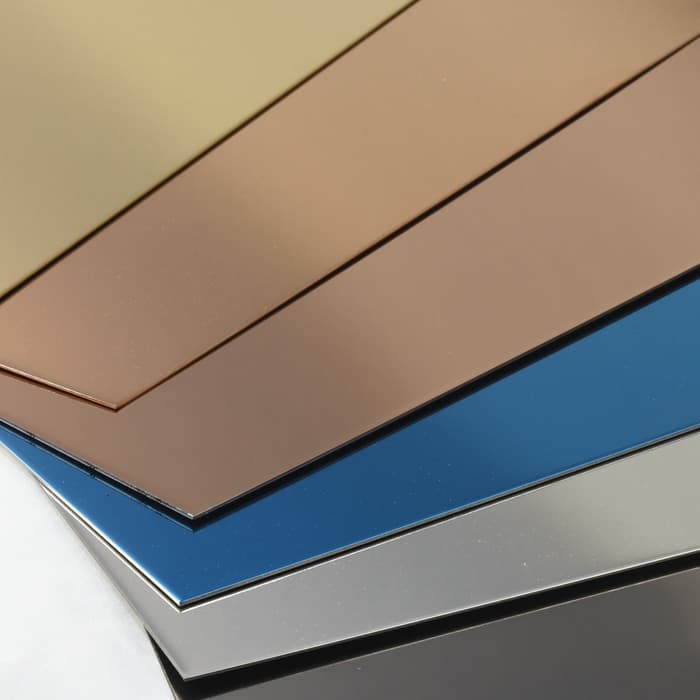
PVD stands for physical vapour deposition. A stainless steel panel is cleaned, loaded into a chamber, and the chamber is pumped down to a vacuum. A metal target, usually titanium or zirconium, is vaporised inside the chamber and reacts with a small, controlled amount of gas. The compound that forms condenses onto the panel as a film thinner than a micrometre in most decorative work, and because it forms atom by atom on a clean surface, it bonds to the steel rather than resting on it.
The colour comes from the compound, not from a pigment. A titanium nitride film is gold; carbon in the gas moves the tone toward bronze and black; zirconium compounds give the paler champagne and brass tones. Colours may include gold, champagne, bronze, copper, black and blue, confirmed against a physical sample. The film is thin enough that the finish underneath still shows, which is the property that makes PVD stainless a material rather than a paint job.
Why the base finish matters more than the colour
Because the film follows the surface it lands on, a PVD colour is only half a specification. The same gold on a mirror-polished sheet is a reflective gold; on a hairline sheet it is a directional, softer gold; on a bead-blasted sheet it is a matte gold with almost no reflection. Our brushed gold PVD finish is exactly that pairing: a mechanically brushed base with a gold film over it, so it keeps the grain and the diffused reflection. When you specify PVD you are specifying two things, the base finish and the tone, and the tone is judged on a physical sample of that base finish, never on a screen.
What PVD changes
- Colour that is part of the surface. A plated or lacquered colour sits on the steel as a separate layer with its own edge; a PVD film forms on the steel's own surface. How that behaves in a given location is confirmed at enquiry, against the sample and the exposure.
- No change to the metal. The film is far too thin to alter the panel's size, flatness or weight; a coated panel is fixed as a stainless panel.
- A consistent tone across a run. The chamber coats a batch under the same conditions, which is why the panels for one lobby are coated together and why a late addition is matched against a retained sample.
What PVD does not do
- It does not hide the surface. Scratches, weld marks and grain direction in the base finish come through the colour. The base has to be right first.
- It does not change the sequence. Cutting, folding, welding and polishing all happen before coating; the panel is coated finished, then film-protected for transport. Fabrication after coating marks the film.
- It does not make a colour swatch a specification. The tone on your base finish, in your hand, under your lighting, is the reference, and that sample is produced before anything goes into production.
Coating in the same building as the cutting, folding and polishing means the base finish and the colour are one responsibility. Exterior exposure, and any question of how a tone will behave in a particular location, is confirmed at enquiry rather than promised here.