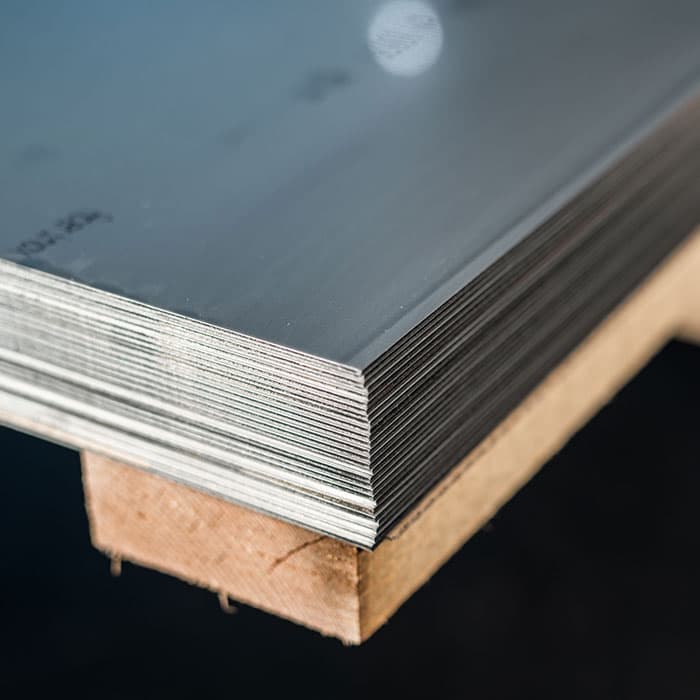
Nominal versus actual thickness, and why a band exists
A nominal thickness is the figure on the order and the drawing. The actual thickness is what a micrometre reads at one point on one sheet, and the two are never expected to match. Rolling works through a gap between two rolls that deflect under load, wear in service and warm through a shift, while the strip entering the gap varies in hardness and temperature along its length. A mill controls the sum of these movements; it does not eliminate it. A standard's tolerance band is the agreed statement of how far that sum may move.
The band is not one number for a product. It widens with nominal thickness, because a heavy gauge cannot be held to the same absolute deviation as a light one; in some standards it changes with width; and where more than one tolerance class is offered, it changes with the class. So "the tolerance on 2 mm" has no answer until the product form, the standard and the class are known.
Two consequences follow. A sheet reading below nominal is not a reject unless it reads below the lower limit of the band the order called up, measured where the standard says to measure, usually at a stated distance in from the edge, because a rolled edge thins. And the band belongs to the product form and the standard, not the alloy: 304 and 316L sheet of the same nominal thickness to the same standard share one band.
Cold-rolled sheet tolerances under EN 10259 and ASTM A480
Cold-rolled sheet and strip are rolled at room temperature between hard, polished rolls, in several passes, from a hot-rolled and annealed coil. Cold rolling holds thickness more closely than hot rolling: the rolls run cool and keep their profile, the strip enters at a uniform temperature, the reduction per pass is small, and the mill gauges the strip continuously and corrects the gap as it runs. A cold-rolled sheet's band is therefore narrower than a hot-rolled plate's at the same nominal thickness.
Two documents govern. In the European system, EN 10259 sets the tolerances on dimensions and shape for cold-rolled stainless wide strip and the sheet and strip cut from it, and the material standard EN 10088-2 refers to it. In the ASTM system, ASTM A480 carries the general requirements for flat-rolled stainless plate, sheet and strip, including permitted variations in thickness, and ASTM A240 refers to A480. A sheet certified to A240 is toleranced to A480 whether or not the order says so; a sheet to EN 10088-2 is toleranced to EN 10259 the same way.
Both documents publish the band as a table against nominal thickness, in places against width too, and the two tables are not identical. "2 mm, ASTM A240" and "2 mm, EN 10088-2" call up different bands, and stock certified to one does not conform to the other until both tables have been read at that thickness. That is why this article prints no bands: the figure that applies is the one in the standard's own table for the ordered thickness, width and class.
Hot-rolled plate tolerances under EN 10029
Hot-rolled plate is rolled from a slab at a temperature high enough for the steel to flow easily, then cooled, annealed and descaled. Its thickness band is wider than cold-rolled sheet's. The rolls run hot, so their profile drifts through a campaign; scale forms and breaks up while the plate is in the stand; the plate cools unevenly from its edges inward; and no cold reduction follows to bring the thickness back to a tight target. A hot-rolled surface is also rougher, so a micrometre reading on it includes the surface profile.
EN 10029 governs hot-rolled plate in the European system; its title places its scope at plate 3 mm thick and above, and EN 10088-2 refers to it. It sets the thickness band by nominal thickness range and offers a choice of thickness tolerance classes, so a buyer who needs a narrower band, or one that runs only upwards from nominal, can specify it. It also covers flatness, with its own classes, plus length, width, edge camber and out-of-squareness. In the ASTM system, ASTM A480 covers plate in the same document as sheet and strip, with separate tables.
For a buyer of plate the direction of the band matters as much as its width. Some classes put most of the allowance on the plus side; a mill rolling to such a class aims above nominal so the plate never falls below the minimum, and the plate that arrives is heavier than nominal. That is the class doing its job, and the section on weight shows what it does to the invoice.
Flatness and edge camber are separate tolerances
A sheet inside its thickness band can still be unusable if it is not flat or its edge is not straight, and the standards treat each separately, so the order must too.
Flatness is how far a sheet lying freely on a flat surface, under its own weight, rises from that surface over a stated measuring length. Edge wave, bow along the length and crown across the width are all flatness defects; they come from uneven elongation across the strip during rolling and from stresses released when a coil is uncoiled and cut. A leveller on the cut-to-length line takes most of this out; the residual is what the flatness tolerance allows. EN 10259 and ASTM A480 set flatness limits for sheet and EN 10029 for plate.

Edge camber is the deviation of one edge from a straight line over a stated length, and it matters most on strip and narrow cuts. It is fixed into a strip when it is slit: a slitting line cuts the mill's wide coil into narrower strips between rotary knives, and each strip inherits the camber of the position it came from. A buyer feeding strip into a roll former or a laser nest sets the camber limit that process can accept.
Edge condition is the last item. A mill edge is the edge as rolled; a cut edge, slit or trimmed, is a sheared edge brought to a stated width, and EN 10259 gives the two different width tolerances, so the order has to say which is wanted. Coil cutting to length gives a sheared end and, with side trimming, a cut edge on both sides.
What to write on the purchase order
An order line reading "Stainless steel sheet 304 2B 2 mm × 1500 × 3000" fixes the grade, the finish and the nominal dimensions, and leaves every tolerance to the mill's default. That is not wrong for general fabrication. Where thickness, flatness or edge matters downstream, the order has to say so, in the vocabulary of the standard it names.
| Product form | Governing standard | What the standard controls | What the purchase order must name |
|---|---|---|---|
| Cold-rolled sheet and strip, EN system | EN 10259, via EN 10088-2 | Thickness, width, length, flatness, edge camber, squareness; mill or cut edge | The standard; nominal thickness, width, length; edge condition; a class only where EN 10259 offers one |
| Cold-rolled sheet and strip, ASTM system | ASTM A480, via ASTM A240 | Thickness, width, length, flatness, camber; where thickness is measured from the edge | The standard; nominal dimensions; sheet or strip, which are toleranced in separate tables; flatness restriction if needed |
| Hot-rolled plate, EN system | EN 10029, via EN 10088-2 | Thickness by range and class; flatness by class; length, width, camber, squareness | The standard; nominal thickness; thickness tolerance class; flatness class; trimmed or untrimmed |
| Hot-rolled plate, ASTM system | ASTM A480, via ASTM A240 | Thickness, width, length, flatness, camber, in separate plate tables | The standard; nominal dimensions; thickness to nominal or to a minimum; flatness restriction if needed |
Two more lines belong on an order that will be measured on receipt: the invoicing basis, theoretical or actual weight, covered next, and what the mill test certificate is to record. The difference between a 3.1 and a 3.2 certificate explains who signs each; if thickness readings are wanted on it, the order has to ask.
How thickness tolerance connects to weight and invoicing
Weight follows thickness directly. The sheet and plate weight calculator runs the expression the quotation uses, length × width × thickness × density, with density from the material master: 8000 kg/m³ for both 304 and 316L. A 3000 × 1500 sheet at a nominal 2.0 mm weighs 72 kg, and every 0.1 mm of thickness on it is 3.6 kg. A sheet that arrives at 2.1 mm weighs 75.6 kg; one at 1.9 mm weighs 68.4 kg. Those two thicknesses are illustrative deviations, not tolerance limits; the real band is read from EN 10259 or ASTM A480.
Plate multiplies the effect. A 3000 × 1500 plate at a nominal 10 mm weighs 360 kg, and every 0.5 mm on it is 18 kg. A plate rolled to a class whose allowance runs upwards and delivered at, for the arithmetic only, 10.5 mm weighs 378 kg. Multiply by the plates on an order and the gap between the drawing and the scale is a line on the invoice.
Which figure is invoiced is a commercial term, which is why the order should carry it. Invoicing on theoretical weight charges the nominal figure whatever the scale reads; invoicing on actual weight charges the scale reading, so a plate rolled to the upper half of its band costs more in proportion. Theoretical weight versus actual weight sets out both practices. Either is defensible; leaving it unsaid until the weighbridge is not.
The arithmetic runs the other way when an order specifies a minimum thickness. "2 mm minimum" obliges the supplier to deliver material reading 2 mm or more at every measured point, which in practice means a heavier nominal, and price and weight follow.
Where Hidayath fits
Hidayath Metal Industries operates from three cities, ten locations and three factories in Saudi Arabia, with branches in Jeddah, Riyadh and Dammam; the group began in 1976. Material supply covers stainless sheet, plate and coil in the grades on the material database, each against the standards its page lists. The processing division runs slitting and coil cutting to length, so width, edge condition and cut length can be fixed on the same order. The request for quotation is where the standard, the tolerance class and the invoicing basis are named.