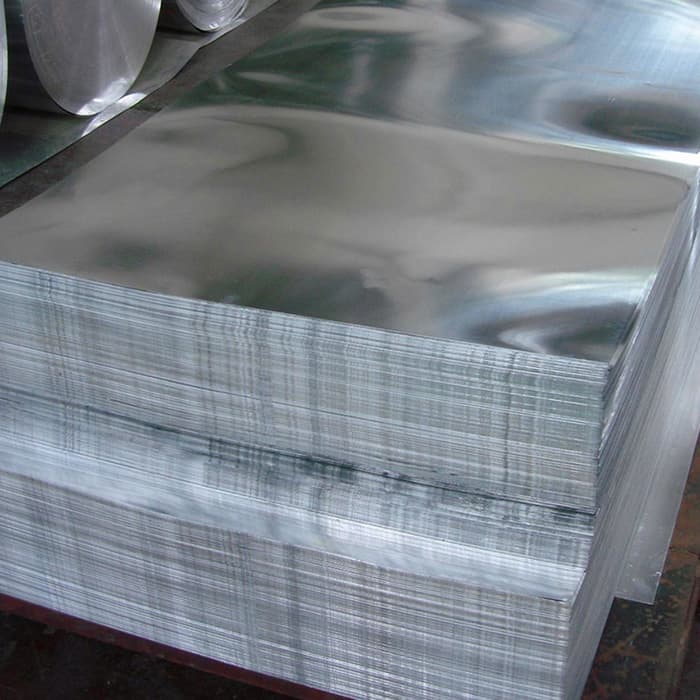
What theoretical weight is and where the density comes from
Theoretical weight is the weight a piece of metal would have if it were exactly the size on the drawing and made of metal at exactly the reference density. For a sheet or plate that is length × width × thickness × density, with the dimensions in millimetres and the density in kg/m³, divided by 10⁹ to land in kilograms. Nothing about the real sheet enters it: not the mill, not where in the tolerance band it was rolled, not how its thickness varies across the width. It is a number about the drawing.
The density is the other half of the product, and it is a reference value, not a measurement. On this site it comes from the material master, one row per grade, and the 304 grade page prints it under its density heading with its source named beside it. 304 sits at 8000 kg/m³ in that table; so do 316 and 316L. Duplex 2205 is carried at 7800 kg/m³ and the carbon structural steels at 7850 kg/m³. Real heats vary by a fraction of a percent around those figures, which is why they are reference values and why the same grade from two mills can weigh slightly differently at identical dimensions.
When the grade is not yet fixed, the metal weight calculator lets you choose a generic family entry instead. The engine then uses a family typical value and says so on the line under the grade: grade density where a grade is named, family fallback where it is not, and the page always tells you which it used. A family figure sizes a lifting plan; the named grade decides the quotation.
Why the mill's tolerance moves the number
A rolling mill does not make a 2.00 mm sheet. It makes a sheet whose thickness lies inside a band around 2 mm, and the width of that band is set by the product standard and the tolerance class on the order. For hot-rolled plate the governing document is EN 10029, which covers plate from 3 mm upwards and offers more than one thickness tolerance class, so the class on the purchase order decides how far the plate may wander. For cold-rolled stainless sheet and strip it is EN 10259 on the European side and ASTM A480 on the American side, the general-requirements specification that ASTM A240 refers to for tolerances. None of those bands is quoted here: the permitted band depends on the standard, the class, the nominal thickness and the width, and a figure lifted from one row and applied to another is worse than none. Stainless steel sheet thickness tolerance sets the bands out by standard.
What matters for weight is that every part of the band is legitimate metal. A sheet rolled at the thin end of its tolerance is fully to standard and weighs less than the calculator says; a sheet at the thick end is equally to standard and weighs more. Length and width carry tolerances too, but on a thin sheet the thickness band is where most of the weight difference lives: a tenth of a millimetre on a 2 mm sheet is a twentieth of the metal.
Surface finish is not part of this: a brushed or polished skin removes microns, and neither the scale nor the certificate can see it. What does register is the measured length of a cut-to-length sheet against its nominal, and on plate a thickness that varies across the width. Both are inside the band; both show on the scale.
Plate vs sheet: which basis is invoiced
There are two ways to price a flat product and the trade uses both. On a theoretical basis the invoice weight is the nominal dimensions at the reference density, multiplied by the number of pieces, whatever the scale reads. On an actual basis the invoice weight is the weighbridge or platform-scale figure for the pieces that were loaded.
In industry practice plate is commonly invoiced on theoretical weight and sheet on actual weight. Plate is thick, its tolerance is small in proportion to its thickness, and it is usually sold in a handful of pieces cut to a drawing, so a theoretical figure is close enough. Cold-rolled sheet is thin, the same absolute tolerance is a larger share of the metal, and a stack of sheets is easy to put on a scale as one lift. The practice is a convention, not a rule, and it varies by supplier, by material and by contract. The only thing to rely on is the quotation: it names the basis the price is built on, and the invoice follows the quotation.
The basis changes what a price per kilogram means: two quotations at the same rate are not the same price if one is on theoretical weight and the other on actual, because only the actual figure moves with the rolling. Compare quotations on the same basis, or ask for a price per sheet.
A worked example: 3000 × 1500 × 2 mm 304
Take a standard sheet, 3000 × 1500 mm in 2 mm 304, at the material master density of 8000 kg/m³. The sheet and plate weight calculator runs the same expression as the calculation engine that prices an enquiry, and every figure in the table came from it.
Sheet / Plate Weight Calculator
Sheet / plate
At nominal thickness the sheet weighs 72 kg. Now suppose the mill delivered it at 1.9 mm, a tenth of a millimetre under nominal, or at 2.1 mm, a tenth over. Those two thicknesses are chosen to show the arithmetic, not because they are the limits of any standard; the real band for 2 mm cold-rolled sheet is set by the standard and class on the order and may be narrower or wider than a tenth either way.
| Thickness | kg per sheet, 3000 × 1500 mm | kg per m² |
|---|---|---|
| 2.0 mm nominal | 72.0 | 16.0 |
| 1.9 mm (illustrative actual) | 68.4 | 15.2 |
| 2.1 mm (illustrative actual) | 75.6 | 16.8 |
Each tenth of a millimetre on this sheet is 3.6 kg, which the engine confirms directly: 3000 × 1500 × 0.1 mm at 8000 kg/m³ is 3.6 kg. That is 5 percent of the nominal weight in either direction, on a sheet that is entirely within specification at both ends. Per square metre the same story reads 16.0 kg at nominal against 15.2 and 16.8 kg at the two illustrative thicknesses, and the per-square-metre figure is the one for comparing thicknesses across a job, because it ignores the cut size.
Scale it to a stack. Fifty sheets of 2 mm are a 100 mm block of metal, and the engine puts 3000 × 1500 × 100 mm at 8000 kg/m³ at 3600 kg. The same fifty sheets rolled at 1.9 mm are a 95 mm block, 3420 kg; at 2.1 mm they are a 105 mm block, 3780 kg. The 180 kg either way is not an error by anyone; it is the tolerance, multiplied by the count, arriving on the weighbridge. On a theoretical basis the invoice reads 3600 kg regardless; on an actual basis it reads whatever the stack weighs.
All of these are theoretical values. They come from nominal geometry at a reference density and carry no rolling tolerance, no measured length and no mill over-rolling; the figure that goes on the order is the one the quotation confirms.
What to ask for on the purchase order
The purchase order is where the ambiguity is removed, and it takes four lines.
State the invoicing basis. Write "invoiced on theoretical weight" or "invoiced on actual weight" against each line, matching the quotation, so that the invoice cannot arrive on a basis the estimator did not price. If the quotation is silent, ask before ordering rather than after weighing.
State the tolerance standard and class. A thickness written as "2 mm" without a standard leaves the band open. "2.0 mm to EN 10259" or "to ASTM A480", with the class the job needs, tells the mill and the supplier what band you are buying, and it is what a gauge on site is checked against.
State the density basis if the price is theoretical. Theoretical weight at 8000 kg/m³ and theoretical weight at a different reference figure are different invoices for the same sheet. Naming the figure, or naming the grade page it is taken from, closes the gap.
Ask for the weights to be recorded. On an actual basis, request a weighbridge or scale ticket for the consignment with the delivery note; on a theoretical basis, request the piece count and dimensions on the same note so the arithmetic can be checked at the gate. Ask for the mill test certificate to travel with the material; mill test certificates 3.1 versus 3.2 explains which type to specify. The certificate carries the heat, the chemistry and the mechanical results, and where the mill reports measured thickness it is the first place to look when a delivered weight surprises you.
Where Hidayath fits
Hidayath Metal Industries operates from three cities, ten locations and three factories in Saudi Arabia, with branches in Jeddah, Riyadh and Dammam; the group began in 1976. The 304 and 316L grade pages carry the density each weight on this site is computed from, with its source named. The sheet and plate weight calculator and the metal weight calculator run the same engine that prices an enquiry, and every result offers a pre-filled request. A request for quotation returns a quotation that states the invoicing basis for each line, which is the figure to plan against.